
Care sheet 03 of 06
Growing Peruvian torch from seed
How to sow Peruvian torch seed: when to sow, a gritty seed mix, surface sowing at about 21 °C under a cover, airing, pricking out and the first winter.
Updated
- Light Bright, no direct sun at first
- Water Humid under a cover
- Cold Keep at about 21 °C
Peruvian torch seed is sown in spring on the surface of a gritty, sterile mix, kept at around 21 °C in a bright place out of direct sun, and covered so the air stays humid until the seedlings are up. The Royal Horticultural Society gives exactly those conditions for cactus seed in its cactus and succulent growing guide: "Sow seeds in spring", "Keep at 21°C in a bright spot, but not direct sun", and "Cover large seeds with grit, but leave small seeds uncovered."
Peruvian torch seed counts as small. The seeds are broadly egg-shaped and 0.9 to 1.1 mm long, according to the species description by Albesiano and Kiesling (2012). Press them lightly onto the surface and leave them uncovered.
What you need
- seed: a packet of Peruvian torch seed, 20 seeds;
- a shallow pot or tray with drainage holes, and a clear lid, plastic bag or propagator;
- a fine, free-draining mix: the RHS cactus mix is 2 parts peat-free John Innes No 2 to 1 part horticultural grit or sharp sand, and for seed many growers sieve it finer and top it with a thin layer of fine grit;
- a spray bottle and a warm, bright spot such as a light windowsill out of the midday sun, or a place under a plant lamp.
The Cactus Growing Kit from Dutch-Smart bundles most of this. The shop describes it as a growing tray with a sealable lid, cactus soil, sand, fine pebbles, perlite and a seed packet of your choice, with instructions. Choose the Peruvian torch option when you order.
Peruvian Torch 20 seeds - Trichocereus peruvianus
View at Dutch-Smart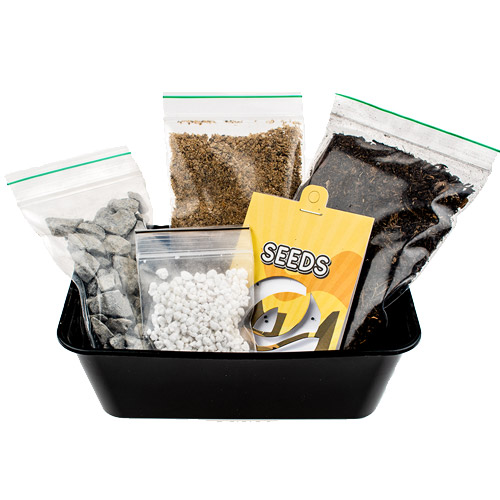
Cactus Growing Kit - Various Species
View at Dutch-SmartSowing, step by step
- Start clean. Use a new or scrubbed tray and fresh mix. Mould and damping off are common seedling problems, and dirty pots and old compost make them more likely.
- Fill and settle. Fill the tray to just below the rim, level it, and water it from below by standing it in a bowl of water until the surface darkens. Let it drain.
- Sow on the surface. Scatter the seed thinly over the surface and press it in lightly with a flat object. Do not bury it. Write the date and the name on a plant tag.
- Cover. Put on the lid or slide the tray into a clear bag. A film of condensation on the inside shows the air is humid enough.
- Warmth and light. Keep it at around 21 °C, bright but out of direct sun. A sunny windowsill under a clear lid can overheat in spring sunshine.
- Keep the surface moist. Mist when the surface starts to dry. Never let a seed tray dry out completely while seed is germinating.
Germination of cactus seed is often uneven, with some seedlings appearing well before others in the same tray. Keep the tray going for several weeks before you decide that nothing more will come up.
After germination
The first seedlings look like tiny green balls with a split at the top. They are fragile in two ways: they dry out quickly, and they rot quickly when air cannot move.
- Once most seedlings are up, start opening the lid for a short time each day and lengthen the time over a few weeks.
- Give more light step by step. Seedlings that stretch and turn pale are asking for more; seedlings that turn reddish are often getting more sun than they can take yet.
- Water from below or with a fine mist, and let the surface dry slightly between waterings once the cover is off.
Pricking out
When the seedlings have grown large enough to handle, move them into small individual pots or a wider tray of the same gritty mix. Lift them with a pencil or a plastic tag, hold them by a spine cluster or the root ball and never squeeze the stem. Firm them in, wait a few days before watering, and keep them out of direct sun for a week or two while they settle.
The first winter
Seedlings in their first winter cannot take the full dry rest that a mature plant gets. Keep them a little warmer than older plants, bright, and only slightly moist, so that they do not shrivel. From the second year they can follow the normal rhythm on the care sheet: generous water in summer, a cool, dry rest from November to the start of March.
Speeding things up by grafting
Peruvian torch seedlings grow slowly in their first year or two. Some growers graft young seedlings onto a vigorous stock to give them a faster start; Peruvian torch itself is often used as that stock for other cacti. The method is on the cuttings and grafting sheet.
Seed of the relatives
If you want to see how close San Pedro and Peruvian torch really are, sow both side by side and compare them in good light after a few seasons, using the field marks on the identification sheet.
San Pedro - 20 seeds - Trichocereus pachanoi
View at Dutch-SmartNext: taking cuttings and grafting · care through the year · what to buy