
Care sheet 01 of 06
How to identify a Peruvian torch
Recognise Echinopsis peruviana by its spines, ribs and stems, tell it apart from San Pedro, Bolivian torch and blue torch, and make sense of its many names.
Updated
- Light Full sun brings out the spines
- Water Ordinary summer watering
- Cold Keep frost-free in a pot
A Peruvian torch is a tall, branching column cactus with blue-green stems, usually six to eight broad ribs and, on older parts of the stem, clusters of up to about 20 spines of which three or four are noticeably longer and stouter, up to about 5 cm. Those strong central spines are the most useful field mark. Everything else, from colour to rib count, overlaps with its close relatives.
The descriptions on this page come from two places: the species account of Echinopsis macrogona on Wikipedia, which summarises the botanical literature, and the taxonomic revision by Albesiano and Kiesling (2012) in the journal Haseltonia, which compared herbarium material, wild plants and plants in cultivation.
The names on the label
The plant on a shop label as Trichocereus peruvianus has had several scientific names, and growers still use the older ones.
| Name | Who and when | Status today |
|---|---|---|
| Cereus macrogonus | Salm-Dyck, 1850 | the oldest name; Albesiano and Kiesling link it to the Peruvian torch |
| Trichocereus macrogonus | Riccobono, 1909 | used by Albesiano and Kiesling (2012) |
| Trichocereus peruvianus | Britton and Rose, 1920 | the name most shops and growers use |
| Echinopsis peruviana | Friedrich and Rowley, 1974 | common in horticultural books |
| Echinopsis macrogona | Friedrich and Rowley, 1974 | the accepted name in Plants of the World Online, with E. peruviana as a synonym |
The common name follows the shape: an upright, torch-like column from Peru. Albesiano and Kiesling place its most plausible wild origin in the middle to high valleys of the Peruvian Andes, at 2,000 to 3,000 metres, and chose as reference specimen a plant collected near Matucana in 1914. The plant is also widely grown in Peru, Ecuador and Bolivia as an ornamental and as a living fence. In Spanish and in the Andes these plants share names with San Pedro, and an ethnobotanical record cited by Albesiano and Kiesling calls the spinier plant San Pedro macho, perhaps because of its stronger spines.
For a grower the practical point is that all of these names can sit on the same plant. When you compare offers or seed lists, read peruvianus, peruviana and macrogonus as the same group.
What to look for on the plant
- Stems. Upright at first, later often arching outward. Wild plants reach 2.5 to 5 metres; stems are mostly 6 to 15 cm thick, sometimes more.
- Colour. Glaucous: a blue-green to grey-green skin with a frosted look. Albesiano and Kiesling name this glaucous skin as one of the features that hold the group together.
- Ribs. Usually six to eight, occasionally five or nine. The name macrogonus means "large edge" and refers to these broad ribs.
- Areoles. Round, about 6 mm across, grey to dark brown, set about 2.5 cm or more apart along the ribs. Just above each areole the rib has a short crosswise furrow, a small notch that is easy to see once you know it.
- Spines. Young areoles carry fewer spines. Older ones can carry up to about 20, with three or four prominent centrals up to roughly 5 cm long and about 1 mm thick. The spines are darker towards the tip.
- Flowers. Funnel-shaped, up to about 21 cm long, with a tube densely covered in brown hairs and pale yellow to yellowish-green tepals, rarely pink. They appear mainly near the top of mature stems; a cutting or seedling will not flower for years.
- Seeds. Small and broadly egg-shaped, 0.9 to 1.1 mm long. That size matters when you sow them; see growing from seed.
Peruvian torch or San Pedro
San Pedro (Echinopsis pachanoi) is the plant most often confused with the Peruvian torch, and botanists themselves disagree on where to draw the line. Albesiano and Kiesling regard both as one species with two varieties, separated mainly by the spines:
| Feature | Peruvian torch | San Pedro |
|---|---|---|
| Spines on older areoles | 18 to 20, of which 3 or 4 are long and robust, about 5 cm | often absent or few, 3 to 7, all similar, about 1 to 2 cm |
| Spine thickness | about 1 mm | less than 1 mm |
| Habit in the wild | branches arching rather than parallel | stems erect, becoming parallel |
| Stem thickness given in the key | 16 to 20 cm | 6 to 11 cm, up to 15 |
There is a catch. The same authors write that spine number and size are "very much affected by light intensity", that cultivated plants can show anything from zero to ten spines at different areoles on one branch, and that a plant moved from shade to a sunnier spot grew more spines. A Peruvian torch kept on a dim windowsill can therefore look like a San Pedro, and a San Pedro grown hard in full sun can look spinier than its label suggests.
The most reliable check is the older, lower part of a well-lit plant. If those areoles carry several long, stout central spines, you are looking at the Peruvian torch type.
Peruvian torch or Bolivian torch
The Bolivian torch (Echinopsis lageniformis, sold as Trichocereus bridgesii) comes from Bolivia, between 1,000 and 3,300 metres. According to its Wikipedia account it has four to eight ribs and only two to six unequal spines per areole, honey-coloured to brown. A Peruvian torch with its crowded, heavy spine clusters on older growth looks clearly different once both are mature.
The Bolivian torch is also sold in a monstrose form with short, knobbly, irregular segments. That form cannot be confused with a Peruvian torch at all.
Not every blue torch is a Peruvian torch
Search for "blue torch cactus" and many results show a different plant. The Royal Horticultural Society lists Pilosocereus pachycladus as blue torch cactus: a Brazilian column cactus with blue-green stems, tan spines and fine white hairs along the areoles, slow-growing and needing greenhouse protection in winter. Those white hairs are the giveaway. A Peruvian torch has no woolly hair along the ribs, grows much faster and comes from the Andes.
A label is a starting point
Peruvian torch plants in the trade are mostly propagated from cuttings of plants already in cultivation, and seed-grown plants vary. Read any label as a good first guess, then look at the spines on older growth after a season in good light. If you would like to compare the three Andean torches side by side, all of them are available as plants or seed:
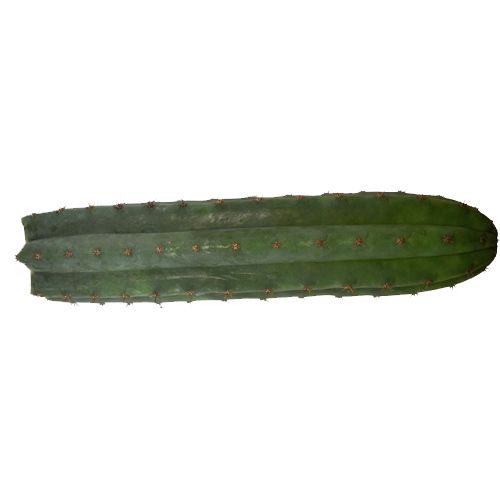
Peruvian Torch 25–30 cm - Trichocereus peruvianus
View at Dutch-Smart
San Pedro - 20 seeds - Trichocereus pachanoi
View at Dutch-Smart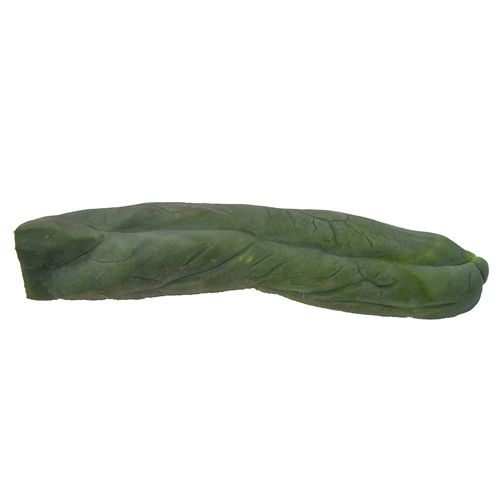
Bolivian Torch 25–30 cm (Penis Cactus) - Trichocereus lageniformis
View at Dutch-SmartNext steps: which cutting or seed to buy, care through the year and what has been measured in this plant.